Thursday, November 1, 2012

Art & Science: Plasma Globes

There is one type of science based art that I never really considered to be "art" until recently when I was trying to think of an awesome project idea for the proposal in this class. Plasma Globes!!! These are so old school, but they are the absolute epitome of art and science together. For starters, they are beautiful to look at, but they are also very interactive and educational science wise. I have always thought plasma balls were cool, but I didn't realize how much goes into making these things work until I did a little research. I found out that plasma balls are clear glass orbs filled with a mixture of rare  gases with a high-voltage electrode in the center of the globe. Plasma filaments then extend out from the inner electrode to the outer glass globe, giving the appearance of multiple constant beams of colored light, which follow your finger or fingers as you touch the outer part of the globe. Pretty cool huh! I also found out that the average plasma globe is only about eight inches tall and/or wide and that the biggest ones are only about twenty two inches tall and/or wide. Also, those bigger globes are only available in museums and are made of a much thicker more durable glass than the average store bought globes, which helps to retain the noble gases for many more years than the smaller ones. Anyway, I just thought I would give my hats off to the amazing, wonderful, awesome, science based, interactive, rarely recognized art called the plasma globe!


Wearable Art by: Markay Schroeder


This seemingly ordinary jewelry is actually considered wearable art, which as we all know by now I just love. So, I thought I'd share a couple of photos with you all and share my interests. The photographs below were created by an artist named Markay Holly Schroeder who is based out of Laguna Beach, California. You can view all of her art pieces on her website at http://www.markayswearableart.com/. I have always thought handmade wearables should be considered as art, because to make any of these types of pieces takes talent, skill, and artistic ability. I hope you enjoy it as much as I do.



Monday, October 8, 2012

Wearable Art & Science:Suzanne Lee's Bio-Couture


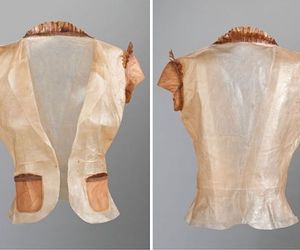
Suzanne Lee's motto is: "Imagine if we could grow fabric." A Senior Research Fellow at London's highly regarded Central Saint Martins College of Art and Design, she's discovered a way to make clothing out of bacterial cellulose using modern science and old fashioned hand stitching, a process she calls "bio-couture." More playfully, she calls her process "how to grow a frock." The cellulose fabric, which looks like human skin, can be molded and sewn. Lee uses fruits and vegetables like blueberries, beetroot, and other natural products to stain the fabrics with handmade patterns and designs. The jacket, above, looks like it has an amazing lightness to it, but in fact, it's very heavy and not easy to stretch. Now, because of the many challenges of working with this material, Lee is starting to collaborate with the chemical engineering and synthetic biology departments at Imperial College of London to try to make the material lighter and more pliable. According to Lee, the striking bodice, above, "...was constructed by applying a pattern of dried beans to a wooden body form and allowing the wet cellulose material to dry down onto it. It took about a week before it could be lifted off. I then sewed in a conventional zip fastening (as yet there is no biodegradable alternative). "The bodice is part of a show at the Mode Museum in Hasselt, Belgium called, Alter Nature: The Future that Never Was, which showcases designers working with innovative materials and processes to address social and environmental concerns.

Please see the photos below to get a better idea of what Lee and her finished projects look like.
To watch a video on You-Tube with Lee showing how she grows the cellulose, just click on the link I provided below.


Wednesday, September 19, 2012

Interactive Portraits

       This time I am blogging about the Interactive Portraits and Body Movies by Rafael Lorenzo-Hemmer on page one hundred of our Digital Art text. I found this very small reading interesting enough to do a bit of research, and what I discovered was equally as interesting in my opinion.

Saturday, September 8, 2012

Blog Two: Modernism vs. Post Modernsim

         I just wanted to start of by saying that I really appreciate the things I learned  in class this week with the Modernism vs. Post Modernism debate. I mean, honestly I thought it was going to be the most boring thing ever, and I was also very nervous about attempting to debate a subject that I still couldn't quite wrap my head around fully, but I must say it did go much better than I expected it to. Plus, I actually think I can understand the difference between Modernism and Post Modernism now. What surprised me most, though, was learning that, looking past all the differences, Modernism and Post Modernism actually have a good bit of common ground, and that sometimes it is extremely difficult to distinguish whether or not a painting is Modern or Post Modern if you don't know the date of the painting. The best example for this is the one we talked a good bit about in the class debate, Marcel Duchamp's Fountain.


          When I first layed eyes on this "art", I was sure right off the bat that it was Post Modern. But then I realized that it's date said 1917. This astounded me! I mean, how could this urinal be called Modern art??? Well, Duchamp's Fountain is Modern art, because of it's date instead of it's style. When I discovered that, I just knew that us Modernists would have a lot of work to do if we were going to argue our way out of this one. In the long run, though, no one on the Post Modernist team used it against us, and actually, us Modernists are the ones that used Duchamp's piece to spark up an interesting debate within our original debate. It was really fun being so controversial. I can't believe I actually had a good time doing a boring old Art History assignment, but I did, and I learned a little something in the process. I learned that there really is no dotted line, so to speak, that separates Modern Art from Post Modern Art. There are no definitives on either side. Art can be Modern and Post Modern at the same time, depending on who is looking at it. Art can be "beautiful" and "crap" at the same time, depending on who the viewer is. I guess one person's trash really is another person's treasure after all. Here is  link to a website I found that sort of integrates all different kinds of art. I hope you'll enjoy it as I do.
http://www.nobullart.com/index.php?L1=main_gallery

Sincerest Thanks,
Nancy Maher


Monday, August 27, 2012

Blog One: Da Vinci's "The Last Supper"


I'm not exactly I'm supposed to be blogging about, but according to the syllabus I'm supposed to  talk about "issues related to this course", "more specifically responding to the lectures and incorporating research related to covered subjects". That being said, here's what I came up with in relation to the first lecture. Mind you, I am totally uneducated regarding ANY art history. So, I was thinking back to what stuck out to me in the first lecture, and my mind pretty much immediately gravitated toward one big name in art history that was mentioned in class, Leonardo Da Vinci. Obviously Da Vinci's name was one of the easier ones for me to remember, being an art history beginner as I am; but more importantly than his name, I meditated a bit on what I learned about how most Renaissance art depicted iconic religious imagery. I think I remembered that because I'm fascinated with the idea of depicting scenes from those bible stories my mom always read to me. Anyway, after pondering Renaissance art a while, I decided to do a scholarly search on Da Vinci. I only found several hundred articles on him and his work, (ha ha) but after reading a few of them, I decided to share this small one I came across in  'Yahoo News'. I've copied and pasted the relative part of the article below for your convenience, but the gist of it is that some British art expert is claiming that Da Vinci painted two hidden portraits of himself within his very famous painting entitled The Last Supper. I found this to be very interesting, as most would, but I wonder if it's really true. I mean, back in the 1980's, people were saying that some rock music had hidden messages within certain songs, but I always thought that was grossly incorrect information even if it was coming from church pastors and so forth. Likewise, I tend to think the same with the claim in this article and ones like it. However, I think I could be more easily convinced about the art than I ever could about the music, especially in light of the fact that the claim originates from an "art expert". I don't know for sure. Take a look at the painting and the article, and you be the judge.

Sincerely,

Nancy Maher

‘Last Supper’ painting may include two Leonardo da Vinci self-portraits

Could both of these "Last Supper" figures be da Vinci self-portraits? (Original image, Wikicommons)Leonardo da Vinci's "The Last Supper" may include two self-portraits of the legendary Renaissance artist, according to a British art expert.
Ross King says the nose, beards and hairstyles of two of the apostles standing to the right of Jesus in the portrait, Thomas and James the Lesser, match a portrait of Leonardo that was made several years after he created his masterpiece.
King told the Independent that while historians have long-suspected Leonardo placed images of himself in his works, no one has thoroughly researched "The Last Supper" for such evidence.
The 15-x-29-foot painting has been the source of endless speculation, though most of the analysis has focused on hidden meanings within the painting itself, such as how each of the apostles is reacting to the revelation that one of them has betrayed Jesus.
Still, King concedes that there is no definitive record of Leonardo's physical appearance but says the Greek physical characteristics were "rarities for an Italian man of that period," according to UPI.
Leonardo da Vinci scholar Charles Nicholl supports King's hypothesis, telling the Independent,"Of all the apostles that [Leonardo] would wish to be identified with, I think Doubting Thomas would be top of his list because Leonardo was a great believer in asking questions rather than accepting what people tell you."
I have copied and pasted the link to the original article below for your convenience.

Thursday, August 23, 2012

Hello!!!!

Hi Professor! I think I set this up correctly. Please let me know if there is anything else I need to do for this blog.

Thanks,
Nancy Maher